Home Battery Basics: Capacity vs Power Explained Without the Marketing
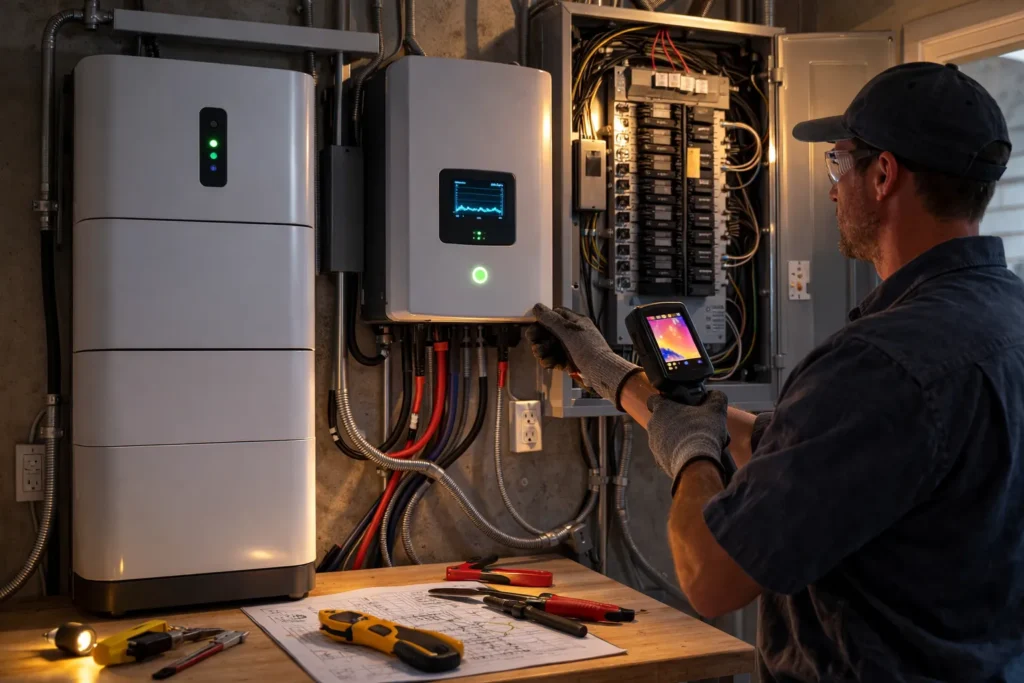
kW is what keeps the lights steady; kWh is how long they stay on. Most disappointment comes from mixing them up.
People shopping for home batteries get steered into a numbers game that’s designed to confuse. Marketing leans on a single headline spec—often “how many kilowatt-hours”—as if that alone tells you whether a battery can run your home. In practice, two separate limits define what you can actually do: energy capacity, measured in kilowatt-hours (kWh), and power output, measured in kilowatts (kW). One is “how long,” the other is “how hard.”
Capacity is the size of the fuel tank. A 10 kWh battery can, in theory, deliver 10 kW for one hour, or 1 kW for ten hours, or any combination that multiplies out to roughly 10 kWh. But that’s a bookkeeping concept, not a guarantee of real-world performance. Usable capacity is usually lower than the headline number because manufacturers protect the battery by reserving a buffer. If the spec sheet doesn’t clearly state usable kWh, you should assume the marketing number is optimistic.
Power is the size of the engine. It determines whether the battery can start and run loads that draw heavily in the moment: well pumps, HVAC blowers, electric kettles, induction cooktops, and especially air conditioners or resistive heating. You can own a large-capacity battery that still can’t start a critical appliance because its inverter can’t deliver the needed kW or surge current. That’s the most common mismatch in home backup setups.
The easiest way to internalize the difference is to separate “energy budgeting” from “instantaneous demand.” Your refrigerator might average 100–200 watts over time, but it can spike much higher when the compressor starts. A battery system must satisfy the spike even if the average is small. That’s why backup design starts with a load list that includes both running watts and starting surge, not just monthly utility bills.
Surge ratings deserve skepticism. Many products advertise a short burst output that lasts only seconds. That can be useful for motor starts, but it doesn’t help if you want to run a 4–5 kW load for an hour. Continuous power is what keeps a house stable during an outage: the ability to hold a certain kW indefinitely without overheating inverters or tripping limits. When comparing systems, continuous kW is usually more important than peak.
There’s also a quiet technical bridge between capacity and power: the C-rate. Roughly, a 10 kWh battery delivering 5 kW is operating at 0.5C. Higher C-rates stress the cells more, drive more heat, and can accelerate degradation. Some chemistries and pack designs tolerate high C-rate better than others, but the practical takeaway is simple: a battery that is frequently pushed hard will usually age faster than one that is sized with margin.
In a real outage, you’re not backing up “the whole home” unless the power rating supports it. “Whole-home backup” is mostly a wiring and controls question, but it’s constrained by kW. Many households do better with a critical loads panel: refrigeration, lighting, outlets, internet, and maybe one HVAC zone. If you try to back up everything, you often discover that a single appliance—an electric water heater or an oven—dominates the kW budget and forces the battery into constant current-limiting.
Runtime calculations are straightforward once you separate kWh from kW. If your critical loads average 1.2 kW and you have 9 kWh usable, you’re looking at about 7.5 hours before losses. But “average” must be taken seriously. If you cycle between 0.4 kW overnight and 2–3 kW during cooking or heating periods, your runtime is determined by the pattern, not the mean. Losses from inverter conversion and battery management typically shave additional energy, so planning with a buffer is not optional.
Solar pairing changes the logic but doesn’t remove it. Solar can extend runtime by recharging during the day, yet you still need enough kW to carry the house at any moment, and you still need enough kWh to bridge night and cloudy periods. A common disappointment happens when owners expect solar to run the home during an outage, only to learn their solar inverter shuts down for safety unless it has a compatible battery and islanding capability. Backup is a system design, not a single product.
AC-coupled versus DC-coupled architectures also affect what you feel in operation. AC-coupled batteries are often easier to retrofit, but they may involve extra conversion steps that reduce efficiency. DC-coupled systems can be more efficient and sometimes offer higher integrated performance with certain solar setups, but they can be less flexible for mixed equipment. These choices don’t change the kWh vs kW distinction, but they can change how much of your theoretical capacity becomes usable in practice and how the system behaves under high loads.
Degradation is the hidden third spec. A battery is not a static asset; its usable kWh shrinks with cycles, time, and heat. High power draw, high ambient temperature, and deep cycling tend to accelerate wear. Warranty language is where reality shows up: cycle limits, capacity retention targets, and exclusions. If a system only meets your needs when it’s brand new, it’s undersized. A resilient setup still works after years of normal use.
The practical sizing mindset is to choose power first, then capacity. Power determines which loads you can support without constant micromanagement. Capacity determines how long you can support them. If you want the house to feel normal, you buy more kW. If you want the house to last through a long outage, you buy more kWh. Most marketing tries to sell you the feeling of endurance while quietly limiting instantaneous capability, because big kWh numbers are easier to headline than honest kW constraints.
A home battery becomes “energy freedom” only when it matches your real load profile and your outage scenarios. Capacity without power is a long-duration battery that can’t carry your home. Power without capacity is a strong sprinter that collapses quickly. The non-marketing truth is that the right system is the one that meets both constraints with margin, and does so in a way that you can actually operate under stress without babysitting an app.